


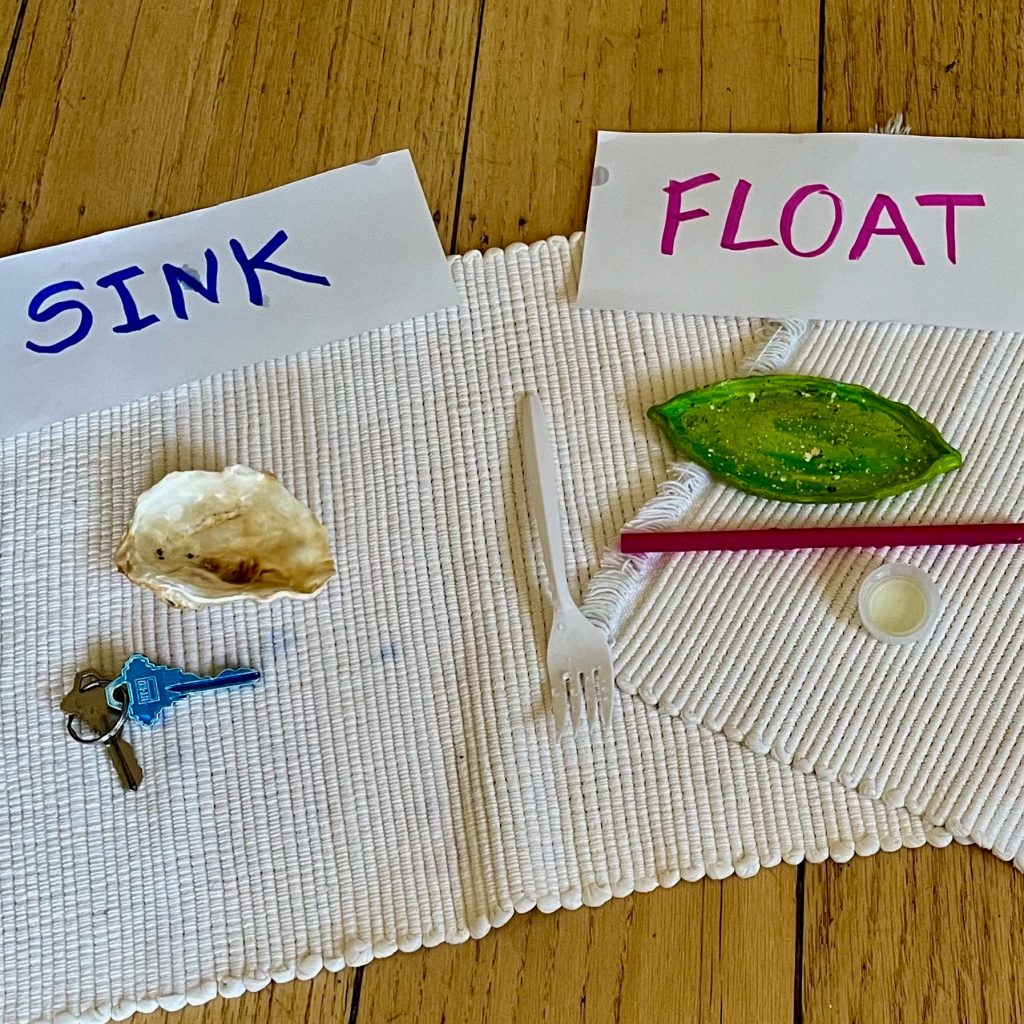
Explore buoyancy and density, and experiment using common household objects to find out which items sink in water (fall to the bottom) and which float in water (stay on the top of the surface).
If you do this activity at home, we’d love to hear how it went. Give us your feedback here.
What We’re Learning & Skills We’re Building
- Buoyancy – the upward force that a fluid (liquid or gas) puts on an object to help it float
- Density – a measure of how tightly packed matter is within a certain space
- Observation – watching and learning how objects behave in a new environment (in water)
- Sorting – grouping objects by certain characteristics, in this case, whether they float or sink in water
- Hypothesizing – making guesses about what will happen to each object based on what is already known about them
Tools & Materials
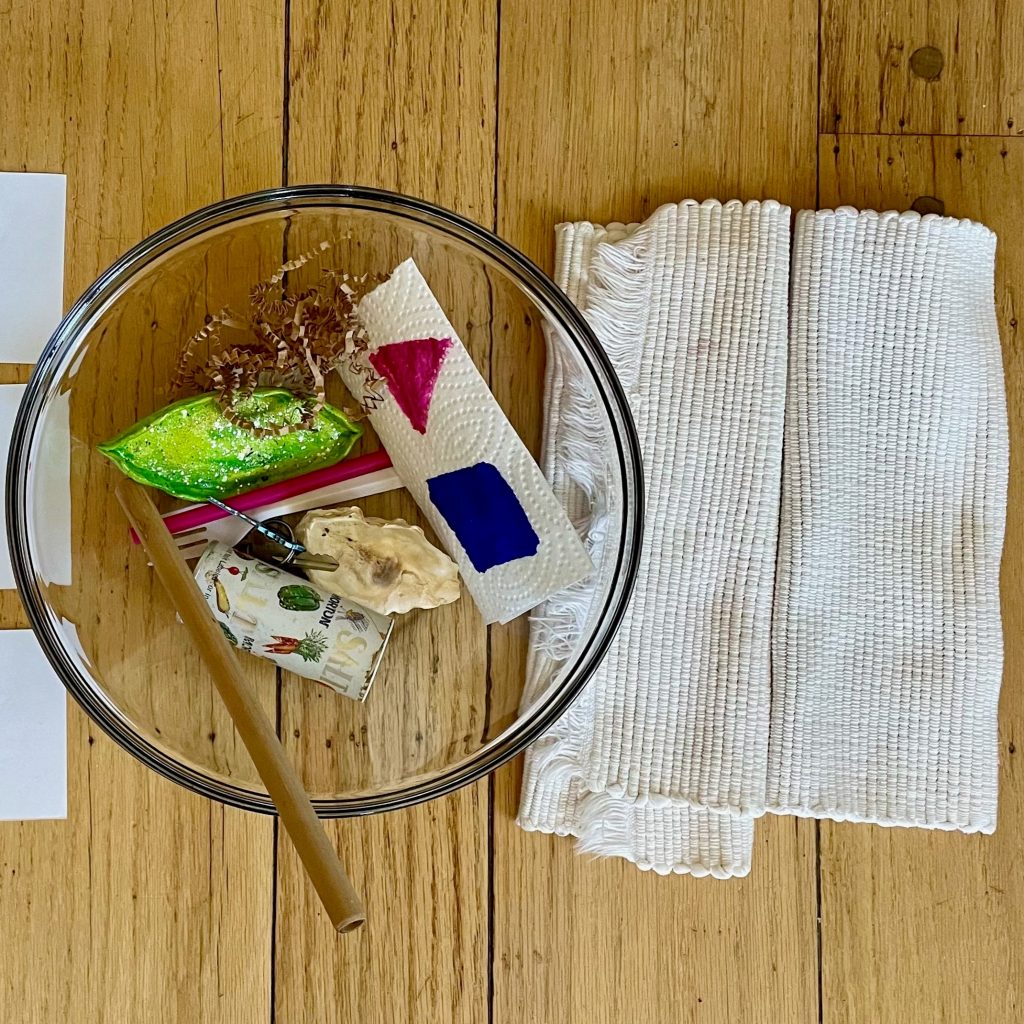
- A large bowl or a small tub of water
- Paper and markers (to create “sink” and “float” labels)
- 2 towels or 2 containers to sort the objects on or into
- Common household objects (NO electronic items; see suggestions below)
Collect items that are safe and ok to get wet, such as:
cups, bottle caps, keys, leaves, paper, cat toys, corks, straws, cutlery, cardboard, TP tubes, pens, pencils, rocks, leaves, sticks, paper towel, aluminum foil (as a flat sheet and balled up tightly), magnets, paper clips, packing peanuts.
Experiment
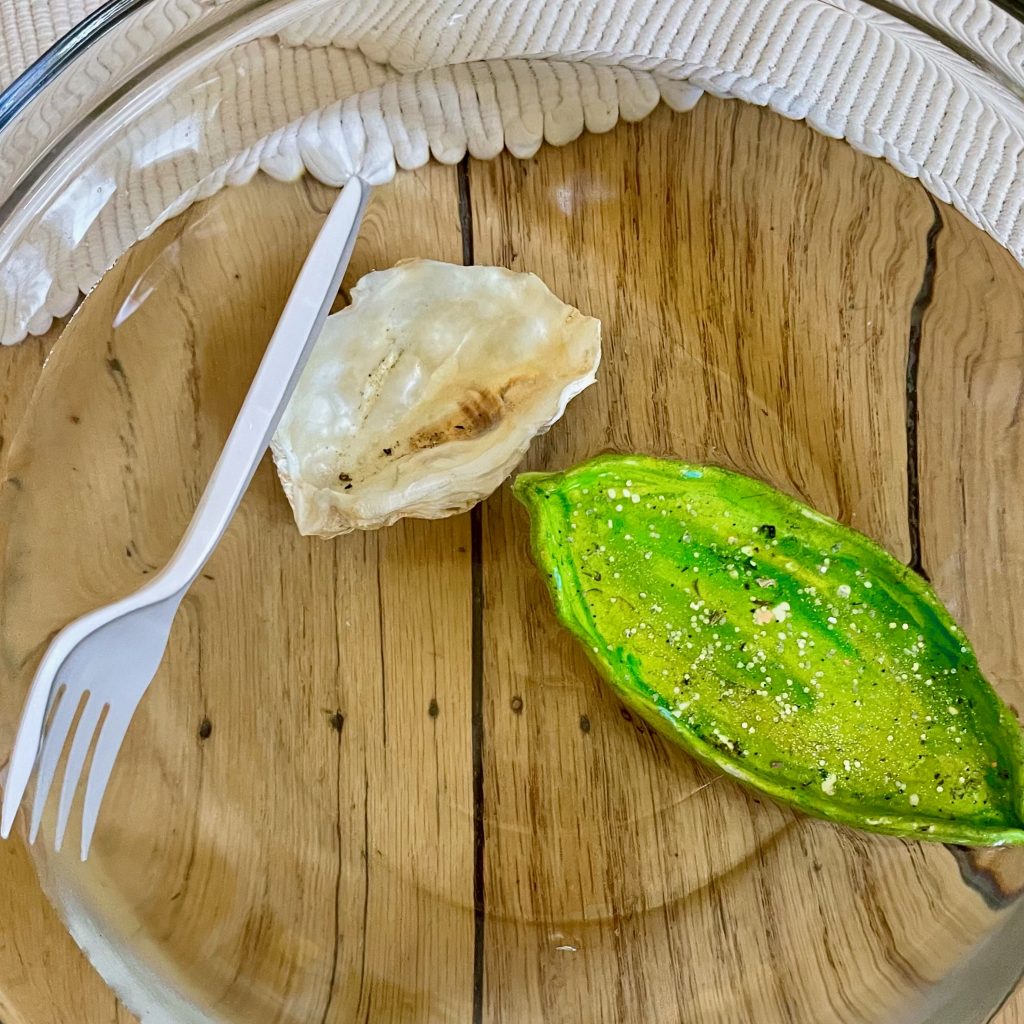
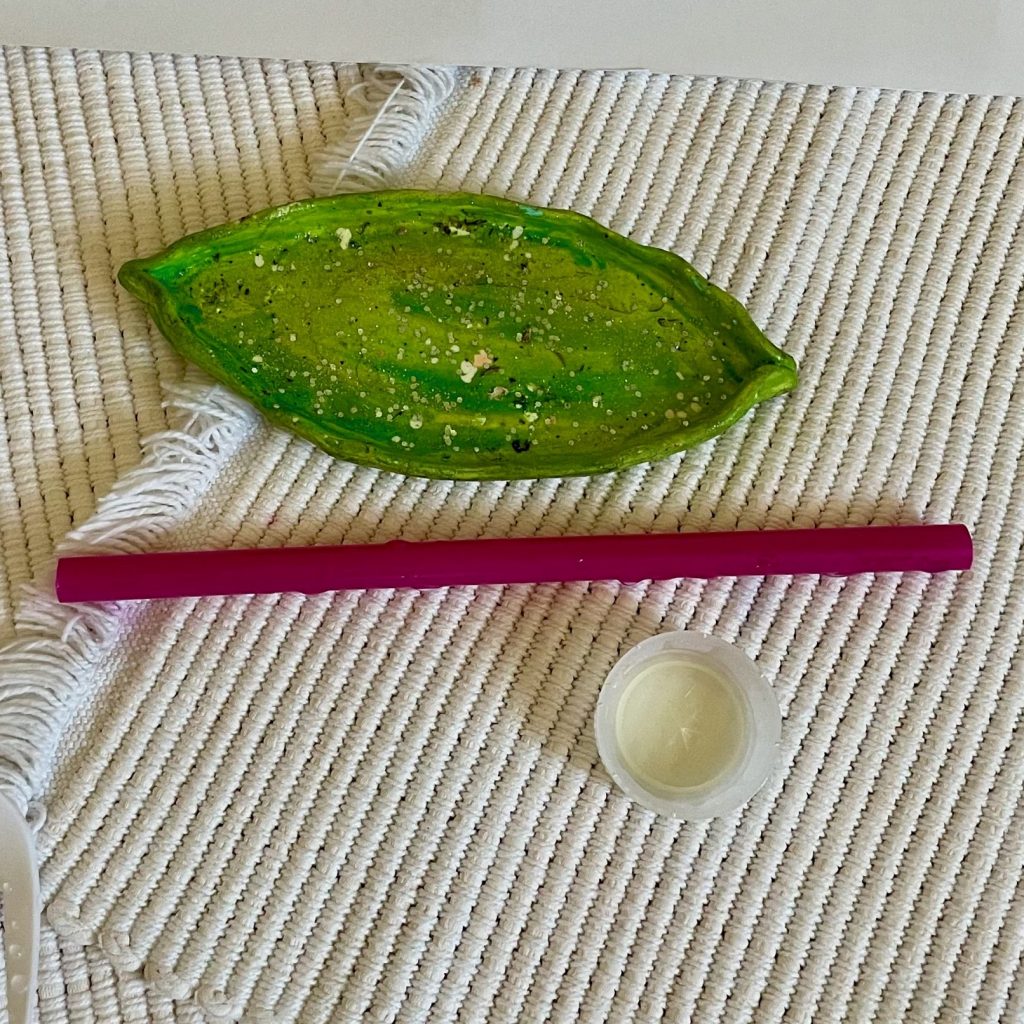
Have your child place and remove each object one by one into the bowl of water. Let the objects to sit in the water for a 30 seconds to 1 minute. Observe whether they float of sink. Remove them and place each in the group of floaters or sinkers.
Observe
• Younger children can simply test out the objects and and see if they sink or float. Assist them in sorting objects into the floater or sinker groups. Let them play with the objects, for example, resting a bottle cap on the leaf. Play is the best kind of experimentation.
• Ask older children questions to encourage scientific thinking: Before they test the objects, ask: “Which ones do you think will float?” “Which do you think will sink?” “Why do you think so?” This is a hypothesis — it doesn’t have to right or wrong, but it will be an idea that will have to be tested over and over before it is proved!
• While testing the objects, talk together about what’s happening to each of them. Ask: “Are you surprised by what happened to any of them?” “What did you expect?” “Why do you think some didn’t work as expected?”
• Sorting can help children make a hypothesis. Ask: “What do all of the items in the floater group have in common?” “How about the sinker group?” Ask them to think about the materials the objects are made of, their shape, their weight, and their size.”
• Many children hypothesize that “heavy objects sink and lightweight ones float.” Ask, “are there any lightweight objects that sink or heavy objects that float?” Hmmm. The aluminum foil can demonstrate that when aluminum foil is a flat sheet it floats, but when it is balled up tightly it sinks. They weigh the same. What is the hypothesis now?
More Learning
- What makes something float and another thing sink is actually surprisingly difficult to explain to young children because it has to do with specific gravity, or comparing an object’s density to the density of water.
- If they are encouraged to think about it, children usually know that very heavy objects like boats can float and some very tiny, lightweight objects will sink.
- Floating happens when an object is less dense than the water. A flat piece of aluminum foil displaces very little water and floats, but a dense (compacted) ball of aluminum foil will displace a lot of water and sink. You can see the amount of water displaced by using a tall narrow glass to drop the ball into after marking the level of the water on the side of the glass. You can also use a rubber band to mark the level. You can see the level go up after the ball is dropped in.
- How does shape change density? You can make a heavy object float by changing its shape. Here’s a fun demonstration: make two balls of modeling clay, each the same size and weight. Drop one into water – it sinks! Now, flatten the other ball into a leaf or a boat shape – it floats! You’ve changed the specific gravity/density of the second ball of clay. This explains why big ships float.